AI Utopia, Well Maybe?
We all wonder about the future. Will our lives become easier? Will we have more free time? Will we be happier? These questions aren't new, but right now they feel more urgent, because of the emerging technological force that could actually change the answers.
The Dream Is Not Unreasonable
Imagine a working week, not too far from now, where you check in on your AI agents over a coffee on Monday morning, point them at the week's priorities, before spending some time on things that actually require being a human. A conversation with a client. A strategic decision. A creative problem that needs judgement and taste. Then after working three hours each day you finish at lunchtime on Thursday for a nice long relaxing weekend.
This is not complete science fiction. Henry Ford introduced the five day work week so that workers would be better rested and therefore increase overall efficiency and production. The AI labs could potentially introduce an even shorter work-week as a way to promote the benefits of their products.
The difference with AI is the pace of change. Previous waves of automation were gradual enough that society had time, however imperfectly, to absorb the disruption. What we're dealing with now feels like something quite different, and that changes everything about how this transition might play out.
The Messy Present
John Maynard Keynes predicted in 1930 that his grandchildren would work a fifteen-hour week, freed by the compounding gains of technology ("Economic Possibilities for our Grandchildren", 1930). He was right about the productivity gains. He was plain wrong about where the time savings would go. And so far with AI, we are too.
From my observations, AI is not letting us work less. For knowledge workers who have adopted these new tools enthusiastically, it is making us work more. Research by Aruna Ranganathan and Xingqi Maggie Ye of UC Berkeley's Haas School of Business, published in Harvard Business Review in February 2026, tracked 200 employees at a technology company for eight months and found that AI tool adoption consistently intensified work rather than reducing it. The hours AI saves get absorbed immediately by higher output expectations, as described by Jevons Paradox. The productivity gains are real, but they are not translating into free time.
Something more subtle is happening too. When AI handles the routine parts of work, what remains is relentless concentration and high-stakes decision-making that can lead to cognitive overload. This is the unglamorous grind of keeping agents running, reviewing what they produce, correcting errors and maintaining pipelines, also known as botsitting. The Glean Work AI Index 2026, which surveyed 6,000 digital workers across the US, UK and Australia, found that workers spend an average of 6.4 hours a week botsitting, more time than they spend actually using AI to produce valuable work. The small tasks that once gave the brain a quiet moment to recover are disappearing. The result is a working day that feels more exhausting than before, even when the output is greater. Anyone who has spent time wading through reams of AI-generated content knows it is not the leisurely future we promised ourselves.
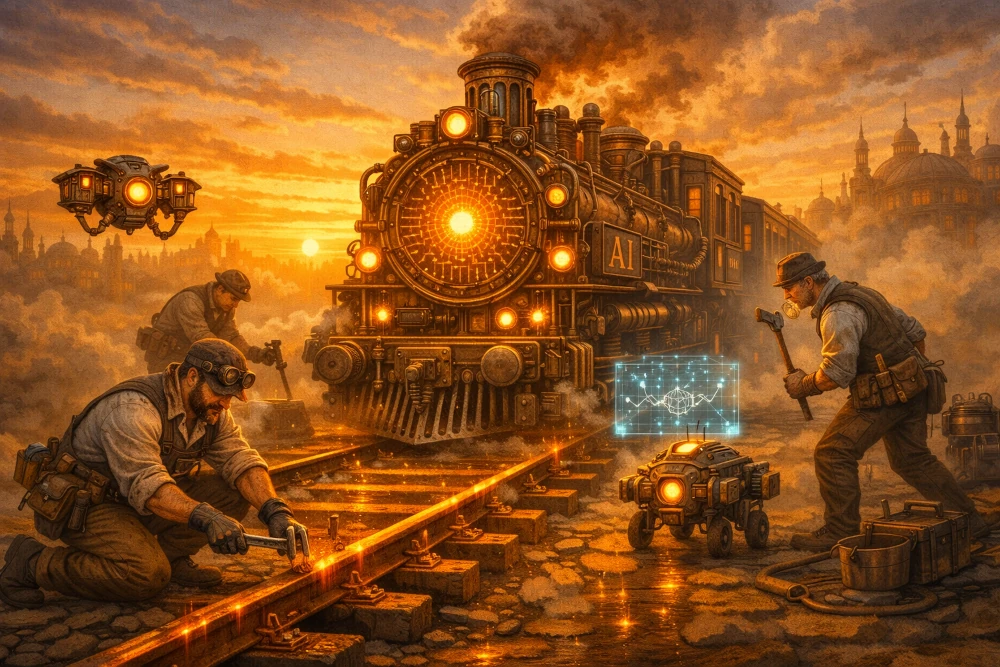
But we may be drawing the wrong conclusion from this exhaustion. The railways did not deliver their benefits the moment the first locomotive was fired up. They required an enormous prior investment of time, capital and human labour, to lay thousands of miles of track, build stations, and figure out how to run a schedule. The productivity and freedom came later, once the infrastructure was in place.
We may be in the equivalent moment with AI: not failing to realise its promise, but laying the tracks. Our agents are still being optimised, our workflows are still being configured, and the guardrails are still being built, all while we are doing our existing jobs. The exhaustion of this period may be the exhaustion of construction, rather than the exhaustion of a broken system. Once the infrastructure matures, and the right automations are in place, the workload may finally start to reduce.
The Distribution Problem
Even if AI eventually creates vast wealth and frees up enormous amounts of human time, there are many unresolved questions: who benefits, and when? The Industrial Revolution created vast wealth, but it took a century of political struggle before that wealth was broadly distributed. The digital revolution has been similarly uneven.
Discussions about Universal Basic Income (UBI) and profit-sharing mandates are well intentioned, but the political, economic and societal challenges are daunting, and the debate has barely moved beyond the theoretical. The transition will be uneven across geographies, industries and income levels, and the support structures people need will likely not arrive in sync with the changes imposed on the labour market.
A Generation Waiting on the Sidelines
There is one group for whom the messy transition carries a particular risk, and it may not be the one most people would predict. The assumption is that young people will adapt most naturally to AI. They are digital natives, comfortable with new technology. Surely they are the winners here?
Comfort with new technology is not the same as having the domain knowledge and experience to supervise it effectively in workplace environments. Entry-level positions have always served a deeper purpose than simply performing basic, repeatable tasks. They provide the environment to build domain knowledge and judgement, how to make ethical decisions, and how to communicate and collaborate with colleagues.
As AI automates the entry-level tasks that provided that foundation, the bottom rung of the career ladder is disappearing. Young people are left in professional limbo, finding it harder to get a foot in the door, since AI can do the basic tasks, and they are not yet qualified or experienced enough to provide sufficient oversight of AI. This could be a lost generation in the making, not through dramatic displacement, but through a quiet stalling.
In addition to learning AI tools and concepts, what young people actually need is tuition in the things that make working with AI genuinely valuable: clear communication, critical thinking and ethical reasoning. The problem is that most education systems are not yet teaching these topics systematically, and the workplace, which traditionally filled that gap, is increasingly hesitant to make the investment. I have written separately about the case for teaching these skills before young people enter the job market: Workplace Readiness Needs to Shift-Left.
The Governance Gap
Layered on top of this is a challenge that rarely features in optimistic projections: the world has not agreed on how to manage any of this. AI governance is a patchwork of the EU's AI Act, American executive orders, and China's own frameworks shaped by its own priorities. International summits in Bletchley, Seoul, Paris and New Delhi have generated shared language but no binding agreements and no enforcement mechanisms.
Chatham House concluded in early 2026 that meaningful global AI governance may only become politically feasible in the event of a crisis. The United States and China are racing to achieve dominance in AI, and neither has a strong incentive to constrain itself in the name of global coordination. The infrastructure for managing a technology of this significance simply does not exist yet.
The history of international cooperation is not a story of elegant solutions emerging smoothly, it's a story of problems eventually being addressed when the pressure exceeds an undefined threshold. Ideally, this would be dealt with proactively, by world leaders coming together to form an international body to monitor and control AI model training and testing. This would effectively enforce a slow-down, giving society a chance to catch up and adapt.
Why Optimism Still Makes Sense
That is a lot to hold at once: burnout in the present, unresolved distribution questions, a generation at risk, and a global governance vacuum. It's tempting to give up on optimism entirely. But technology has always confounded pessimists, and sometimes in ways that seem almost comical in retrospect.
When trains were invented in the early nineteenth century, some physicians warned that the unprecedented speed and acceleration would crush passengers' internal organs. The fear was real, and the technology was genuinely new and strange, but the critics were wrong about what it would do for humanity. It connected people, opened up economies, and shrank the world in ways that were overwhelmingly positive. You might say that this AI transformation is different, but weren't they all different in the past too?
As AI emerges from the trough of disillusionment it will hopefully follow a similar path. The concerns are not irrational, but the typical path of technological evolution, however messy, has generally led to greater prosperity and human capability. And unlike previous technologies, AI could help solve problems that have stumped us for decades: accelerating drug discovery, improving education, addressing climate change and making expertise more widely accessible. The potential upsides can't be ignored.
The governance gap is worrying, but governments are starting to pay attention as more powerful models are released. The conversations about sharing AI-generated productivity and financial gains with workers are also happening now in ways they weren't a few years ago.
The Gap Between Here and There
The hardest part of being an optimist about AI is not believing the destination is good, it is holding that belief while being honest about the distance between here and there. The transition will be messy. The governance and alignment questions are nowhere near resolved. The wealth distribution problem will not sort itself out without deliberate political leadership that is unlikely to happen quickly, if at all. And a generation of young people risk being stalled at the starting line.
But a future with more free time, more connection, more human freedom is not a naive dream. It is quite plausible, if we are willing to do the hard work of building the social, political and institutional structures that would allow it to arrive equitably.
For now, a leisurely coffee with friends in the afternoon is still aspirational. Most of us are reviewing agent outputs and wondering where the afternoon went. That is the honest place we are in, and it's worth acknowledging, even for those of us who remain convinced it's not where we will end up. As for a four day work week, we can only live in hope!
Further Reading
- Workplace Readiness Needs to Shift-Left
- The AI Adoption Gap: Why Regulated Companies Can't Move As Fast As The Hype