Career Planning in the AI Era
We can't predict the future, but some things can be foreseen with a reasonable degree of certainty based on previous trends. We've lived through many evolutions of technological advancement and can imagine how things will evolve and the impact they will have over time; however, predicting a timeline is notoriously difficult.
With continual advances in AI technologies, big changes are coming to how we work, whether we like it or not. We don't know exactly what form these changes will take, but they are coming and they will be disruptive so we all need to be willing and ready to adapt.

This guide focuses primarily on software engineering while also considering broader changes to knowledge work. If you're entering the job market, anxious about the impact of AI on your career, or managing teams through this transition, understanding the stages ahead will help you make better decisions today to prepare for the future.
The Onboarding Paradox
As AI increasingly automates basic tasks and repetitive work, leaders are forced to rethink their workforce strategies, with many companies implementing hiring freezes. The focus is shifting towards empowering experienced employees to manage AI agents, leveraging their expertise to optimise workflows and boost productivity.
But this creates a paradox. If companies don't hire new employees, who will have the knowledge to manage AI agents in the future as experienced employees move on or retire? For people entering the job market, how do they gain the experience needed to effectively manage AI agents and judge whether they're performing correctly?
The traditional career path, starting in narrow roles and gradually expanding expertise over years, is no longer practical.
This paradox demands a fundamentally different approach to career development, one focused on broader system thinking and adaptability from day one.
Four Stages of AI Advancement in Work

Understanding where we are and where we're going will help to plan your learning investments wisely. Let's examine each stage in detail, starting with where we're at today.
Stage 1: AI as Task Automation Assistant
What AI Can Do
AI assistants handle discrete, well-defined tasks within larger workflows. In software engineering, this means: boilerplate project setup, code completion, bug detection, and writing documentation. AI assistants require detailed prompts and constant oversight.
General Work Impact
AI assists skilled workers in specific tasks. Lawyers review AI generated document summaries, marketers use AI for initial content drafts, data analysts use AI to clean datasets. Humans drive all decisions and review all generated outputs. Companies begin questioning whether they need as many entry-level positions.
Software Engineering Reality
A skilled engineer writes detailed prompts and instruction files directing AI assistants to write code using specific languages, technologies, and conventions. Humans maintain control by reviewing the generated code continuously and steering the AI to ensure quality output. AI is a productivity multiplier for those who already know what good looks like.
The Critical Gap
Junior engineers entering the job market now face the challenge of learning to review AI outputs without having the experience and intuitive pattern recognition that comes from writing thousands of lines of production code themselves.
Stage 2: Agentic AI for Full Feature Delivery
What AI Can Do
AI agents have rapidly matured to handle complex, multi-component implementation tasks. Moving beyond the generation of single functions, agents now deliver entire feature modules: database migrations, API endpoints, frontend components, working across the technology stack with moderate supervision.
General Work Impact
The bottleneck shifts from deep specialised knowledge within narrow domains to the ability to orchestrate AI agents across end-to-end business processes. Employees who understand how systems and processes fit together become disproportionately more valuable compared to those with deep but narrow expertise.
Software Engineering Reality
A skilled fullstack engineer can direct an AI agent to build a complete feature in a fraction of the time previously required by a full team of specialist engineers.
The key shift: specialist engineers utilising AI may find themselves bottlenecked waiting for other parts of the system to be implemented by other engineers. A fullstack engineer who can break down complex problems into AI-directable tasks, and review the AI-generated code across the full stack has a distinct advantage.
The Critical Challenge
Code review becomes the primary bottleneck in the Software Development Lifecycle. If code reviews require multiple specialists, the productivity gains from the AI agent are greatly reduced. Organisations need software engineers who can conduct effective code review across the full stack, checking for security, performance, and quality across all components.
Stage 3: AI as Universal Implementer (Emerging)
What AI Can Do
AI agents navigate and modify large, complex codebases with minimal guidance. They understand the business context, make reasonable architectural decisions within established patterns, and can refactor entire subsystems. The AI doesn't just implement, it suggests approaches and evaluates tradeoffs.
General Work Impact
Employees must prioritise fundamental knowledge that ages slowly and applies across business contexts: core principles, patterns, and mental models rather than specific tools or syntaxes. The ability to learn quickly and apply first-principles thinking becomes the differentiating skill. Specialist expertise remains valuable, but only when combined with broader design thinking.
Software Engineering Reality
AI agents handle the bulk of implementation and integration work across the stack. The human contribution centres on agent management, architectural design, system decomposition, and quality verification. Engineers must ask: Does this solution follow sound architectural patterns? Is it secure? Does it scale? Is it maintainable?
The most valuable software engineers are those who understand the broader system architecture and can critically assess the quality of AI generated solutions against fundamental principles and requirements.
The Identity Shift
This stage requires software engineers to fundamentally reimagine their professional identity. If you built your career on deep and specialist expertise (in JavaScript / micro-services / database development / distributed systems optimisation), you must now broaden your understanding of architectural fundamentals across all of these domains rather than being an expert in just one.
This isn't just a skills challenge, it's a self-reflective transition that requires humility and a willingness to be a beginner again in adjacent domains.
Stage 4: AGI & Autonomous Knowledge Work (Future State)
This stage is highly speculative, both in timeline and form. I include it for completeness, acknowledging the limited ability to predict this far ahead.
What AGI Might Be Capable Of
Artificial General Intelligence (AGI) represents AI systems that can autonomously handle the vast majority of complex knowledge work across all domains. Unlike earlier stages where humans direct AI agents, it's likely that AGI systems will independently understand the context of problems, devise solutions, implement them, and iteratively adapt and learn based on outcomes, all with minimal human guidance (presuming that alignment is a solved problem).
Possible Human Roles
If and when this stage arrives, human work will shift dramatically:
- Creative direction: Defining what should exist, not just how to build it. The "why" questions that require human context, culture, and vision
- Governance and oversight: Setting boundaries, defining what systems should and shouldn't do, especially in regulated industries such as healthcare, finance, and law where human accountability remains essential
- Value alignment: Ensuring AI systems pursue goals that align with human values and societal good
- Edge cases and exceptions: Handling situations that fall outside normal parameters, where human judgement and empathy are irreplaceable
- Interpersonal work: Roles that inherently require human connection, trust, and emotional intelligence
Why This Is So Uncertain
Predicting this stage is challenging:
- We don't know if current AI architectures can scale to true AGI, or if fundamental technology breakthroughs are required i.e. in real-time learning
- The timeline could be 5 years, 10 years or 50+ years, or AGI might not arrive at all
- The transition could be gradual (extending Stage 3 indefinitely) or sudden and massively disruptive
- Regulatory, ethical, and societal factors may shape or limit AGI deployment regardless of technical capability
What This Means for Your Career
Rather than planning specifically for Stage 4, focus on building adaptability as a skill. The software engineers who thrive during Stages 1-3 by embracing continuous learning, developing architectural thinking, and staying grounded in fundamental principles will be best positioned to navigate whatever Stage 4 brings, if it arrives at all.
It's impossible to fully future-proof your career against AGI, the goal is to build the learning capacity and adaptability that makes you valuable through multiple waves of change.
Reclaiming the "Software Engineer" Job Title
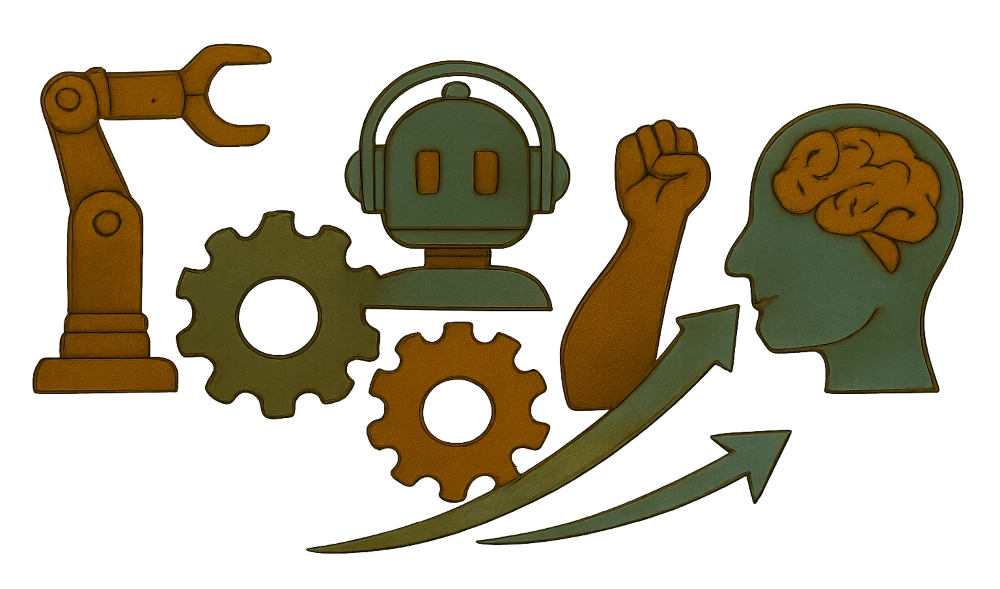
The pattern across the stages of AI advancement is clear: software engineers who can work across the full stack with architectural thinking become increasingly valuable.
Martin Fowler's writing on Expert Generalists describes this profile well: someone with deep understanding of fundamental principles that apply across domains, broad exposure to multiple areas of the stack, and the ability to see how components fit together into coherent systems.
However, the term "Expert Generalist" has a limitation as a job title. It doesn't scale down the experience ladder. "Junior Expert Generalist" sounds contradictory. In practice, “Expert Generalist” describes a mindset rather than a job title.
I suggest we reclaim the "Software Engineer" job title as it was originally used, before it got prefixed with so many narrow specialisations. A Software Engineer builds software systems across the full stack. Not just frontend, not just backend, but complete systems, as it once was.
The career progression was as follows (or a variation of): Junior Software Engineer, Software Engineer, Senior Software Engineer, and Principal Software Engineer. With the understanding that these engineers work across the full stack, not in narrow silos.
The Strategic Advantage
Software Engineers can:
- Direct AI agents more effectively because they understand what good looks like across the full solution space
- Break down complex problems into AI-directable tasks that span the entire stack
- Review AI-generated code for systemic issues and quality, not just surface-level correctness i.e. spot when an AI's frontend solution will create backend performance problems, or when a database design will cause UI responsiveness issues
As AI capabilities advance, we need more software engineers who think this way, regardless of their experience level. The difference between a Junior Software Engineer and a Principal Software Engineer isn't the scope of what they can work on, it's the depth of architectural judgement and the complexity of problems they can solve.
A Career Development Path for the AI Era
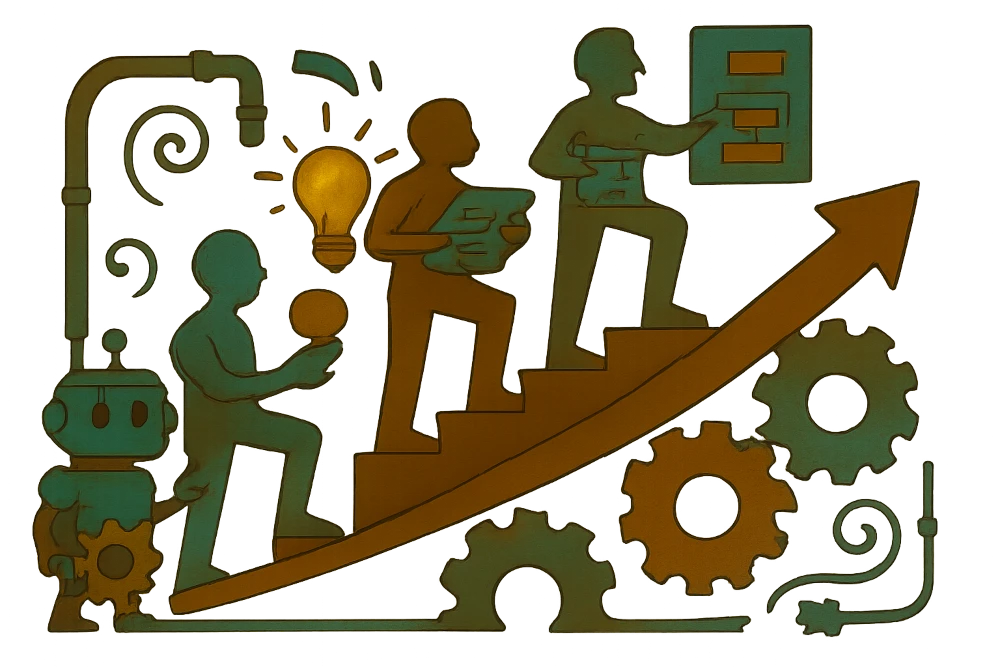
The traditional career path of starting narrow and gradually expanding won't prepare graduates quickly enough. Here's how to position yourself based on where you are in your career:
If You're Entering the Field (Students & Career Changers)
Your goal: become AI fluent while building fundamental knowledge, avoiding the trap of becoming dependent on AI for things you should understand yourself.
Immediate Actions (Months 1-6)
1. Build AI fluency as a learning tool, not a crutch
- Use AI to explain and learn new concepts, not just generate solutions
- Use AI to review its generated code and explain its reasoning: "Explain why you chose this approach" or "What are the tradeoffs of this solution?"
- Develop the habit of asking "Why?" before accepting any AI suggestion
- Use AI to refactor code that looks overly complicated
2. Focus on fundamentals over frameworks
- Instead of only mastering the most popular UI framework, understand the concepts of UI rendering and state reconciliation patterns
- Instead of relying solely on ORMs, learn about SQL, data modelling, indexing strategies, and query optimisation principles
- Study distributed systems concepts: messaging, partitioning, replication, consistency, fault tolerance
- Learn security fundamentals that apply across languages and frameworks: authentication, authorisation, input validation, encryption, secure session management, and the OWASP Top 10
3. Practice full-stack thinking from day one
- Build small but complete projects that touch every layer: database, API, frontend, and deployment pipeline
- Don't just make it work, understand the tradeoffs you're making at each layer
Medium-term Development (Months 6-24)
4. Develop code review skills across the stack
- Review others' code in domains outside your comfort zone
- Learn to spot architectural problems by asking AI to explain code in unfamiliar areas: "What security vulnerabilities might exist in this code?", "How could this be exploited by a malicious user?", "What performance issues could arise at scale?"
- Develop an adversarial mindset: always ask "What could go wrong?" and "How might this be abused?"
5. Cultivate the right mindset
- Curiosity: Default to "I want to understand why this works" not "I just need it to work"
- Humility: When learning new domains, seek to understand why existing approaches exist before assuming you know better
- Customer focus: Always ask "How does this technology choice help the user?"
- Sympathy for adjacent domains: If you're working on backend, think about the needs of the frontend; if you're doing UI work, consider data processing and storage constraints
6. Find mentors with experience across the full stack
- Seek out experienced engineers who've successfully worked across multiple domains
- Be curious and don't hesitate to ask for guidance, this is a strength, not a weakness
- Ask them: "How do you approach learning new domains quickly?"
If You're Established in Your Career (Mid-Level and Senior Engineers)
The challenge is to expand from specialist depth to generalist breadth while gaining broader knowledge of full system architecture design.
Assess Your Current Position
Are you primarily working in one area of the stack? Do you feel uncomfortable reviewing code outside your domain? When AI generates code in unfamiliar territory, can you evaluate its quality? If the answer to these questions indicates narrow specialist expertise, now is the time to expand your skillset.
Expansion Strategy
1. Map the full stack and identify your gaps
- Where are you strong? Where are you weak?
- What domains do you actively avoid or defer to others?
- Prioritise learning adjacent domains first (backend engineers learn frontend, frontend engineers learn backend APIs and data modelling)
2. Learn through doing, with AI as a guide
- Create personal learning projects that span the full stack, related to a hobby or interest (music apps, cooking planners, sports trackers).
- Take on work tasks outside your primary domain
- Use AI to accelerate learning: "Explain the standard patterns for X" or "What are the common mistakes in Y?"
- Have experienced engineers review your work in new domains and learn from their feedback
3. Study architectural patterns, not just implementation details
- Read about system design patterns: microservices, event-driven architecture, CQRS, serverless patterns
- Understand tradeoffs: When is a monolith better than microservices? When should you denormalise data?
- Learn to think about quality attributes: How does an architectural decision affect security, data privacy, scalability, maintainability, and cost?
4. Practice system decomposition
- When building complex features, practice breaking them into AI-directable tasks (AI can also help define the breakdown)
- Think about: What are the domain boundaries? What are the contracts between components?
- Learn to write clear specifications in a logical sequence that AI can implement: clear requirements, constraints, and quality criteria
5. Transform your identity gradually
- Recognise that letting go of deep specialist identity is difficult but necessary
- Reframe expertise: You're not losing your depth, you're adding breadth
- Build confidence in new domains through small wins
- Find communities of other generalists who are on the same journey
If You're Managing Teams or Hiring
Rethink your hiring criteria
- Prioritise candidates who demonstrate learning agility and fundamental understanding over those with deep but narrow expertise
- Look for evidence of cross-domain thinking and curiosity
- Test for judgement in architecture design, not just coding ability
- Test for prompt engineering skills
Restructure onboarding
- Don't silo new hires into narrow roles
- Plan for rotation of tasks across different parts of the stack
- Pair juniors with experienced engineers who can provide coaching on full-stack thinking
Invest in upskilling
- Provide training that focuses on patterns and principles, not just tools and frameworks
- Create opportunities for specialists to expand into adjacent domains
- Reward engineers who successfully deliver across the full stack
Skills That Matter Most

As you navigate this transition, focus on building these core competencies:
1. System Architecture Design
Understanding how to structure systems for security, performance, scalability, maintainability and reliability. In the AI era, architectural decisions have amplified consequences as AI agents implement your designs at speed. A flawed architecture design that might have been caught during manual implementation can now be replicated across an entire codebase before you notice.
2. AI Agent Management
Knowing how to prompt, instruct, direct, and review AI outputs effectively. This includes understanding AI's limitations and blind spots, particularly around security and data privacy. AI agents can inadvertently introduce vulnerabilities like SQL injection, insecure authentication, or exposed API keys if not properly directed. Learn to ask AI: "What security considerations should I be aware of with this approach?" and verify the answers.
3. Full-Stack Code Review with Security Rigour
The ability to evaluate code quality across all layers for security, performance, and maintainability is critical. As AI generates code faster, threat modelling and security review becomes more important and more challenging. You need to spot not just obvious vulnerabilities but architectural security flaws: authentication weaknesses, privilege escalation, data exposure risks, and insecure dependencies.
The advanced capabilities of AI are a double-edged sword: AI builds amazing software faster, but malicious actors also use AI for more sophisticated attacks. The key difference in the AI era is that attacks will be more innovative, more intense, and happen more rapidly. Your secure code review skills must evolve to match this threat landscape.
4. Problem Decomposition
Breaking complex challenges into clear, implementable and testable components. This includes decomposing security requirements alongside functional requirements. When directing AI to build features, you must specify not just what it should do, but what it must never do: "Implement user authentication with OAuth, rate limiting on login attempts, and never store keys in config files."
5. Fundamental Knowledge
Deep understanding of principles that transfer across technologies:
- Security principles and threat models (authentication, authorisation, encryption, input validation)
- Data modelling and management patterns
- UI rendering and state management
- Performance optimisation strategies
- Network protocols and distributed systems
Security fundamentals deserve particular emphasis. Understanding concepts like the principle of least privilege, defence in depth, and secure defaults will serve you regardless of which languages, frameworks, or AI tools you use. These principles guide how you direct AI and what to look for during code review.
Looking Ahead
We're living through the early stages of this transformation right now. The exact timelines remain uncertain but the direction is clear.
The traditional career path of building deep expertise in a narrow domain served engineers well for decades. That career path is still valid in some cases, but it's becoming a higher-risk strategy. The engineers who will thrive in the AI era are those who:
- Embrace continuous learning as a core part of their identity
- Build breadth of knowledge while maintaining rigour in their thinking
- Stay grounded in fundamental principles while adapting to new domains
- Use AI as a collaborative tool that amplifies their judgement, not as a replacement for understanding
The future belongs not to those who know the most about one thing, but to those who understand how everything fits together and can orchestrate AI agents to build complete, coherent solutions.
What's Next?
Read the AI Agent as a Software Engineering Learning Coach article for practical guidance on how to accelerate your learning.